The Hyper Information Age
From Friedrich Hayek's 1945 work "The Use of Knowledge in Society":
If we possess all the relevant information, if we can start out from a given system of preferences, and if we command complete knowledge of available means, the problem which remains is purely one of logic.
Hayek's argument echoes a broader trend in intellectual history. Across economics, physics, and philosophy, scholars repeatedly asserted that access to the right information could resolve the problem of uncertainty.
Albert Einstein was a determinist. In the context of physics, he believed that understanding the state of the world right now would give us knowledge into where we came from (past) and where we may be headed (future). Pierre-Simon Laplace had a similar idea that is now referred to as Laplace's Demon.
The key issue is knowing what state we are in today in order to apply the right logic. And that starts with access to information.
Hayek's central argument in his essay was that central planning cannot effectively be conducted due to the immense difficulty of acquiring data. Logical argument is relatively simple, but building the context and right abstraction that exemplifies the world is what tends to be the most difficult part.
Today, three key shifts are changing this:
- Devices allow us to capture more information
- A hyperconnected society allows us to unearth useful information
- Advanced information processing capability allows us to extract previously hidden information through transformations
Combined, we are dramatically lowering the cost of acquiring, processing, and utilizing data.
We are already entering the hyper information age as a result. Recent wars across Ukraine and Iran have shown that first-hand information from the war can be acquired, in high fidelity videos nonetheless. Prediction markets are offering bounties to mine private information, resulting in phenomenon like the infamous Pentagon Pizza Index. Google DeepMind has shown with AlphaZero that superhuman capability can emerge from simple rules and iterative self-play - through computation, systems can extract and construct structural information not obvious in the original data.
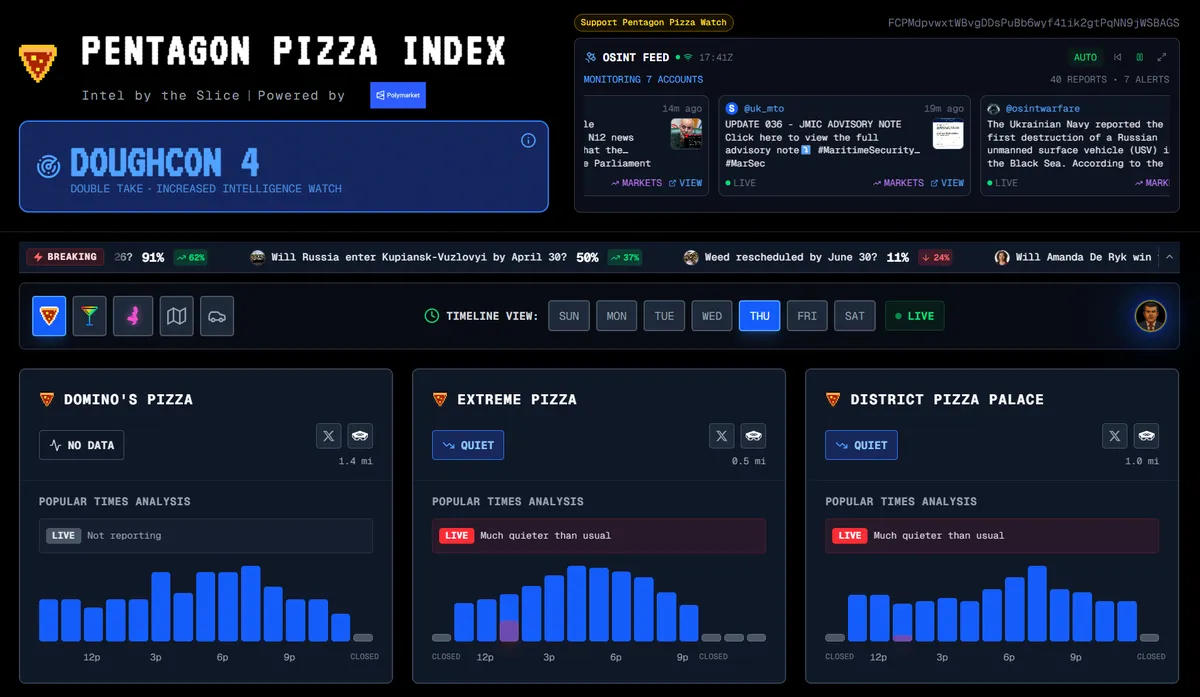
Information is no longer the bottleneck. The challenge now is ranking signals, assigning confidence, and translating probabilistic knowledge into action. In that world, systems with explicit resolution mechanisms may create the strongest feedback loops.